In true German style, we rested from jetlag one day before setting out o
 n a short wanderung (hike) with Jochen's family. It was 7 miles roundtrip -- the first 3.5 miles uphill!-- to Burg Teck (a small fortified castle that sits above the region of Germany where Jochen grew up). The German countryside was a lush mixture of deep greens and the boys were happy to spend the day outdoors with their cousins after our 24-hour trip (door-to-door) to Stuttgart.
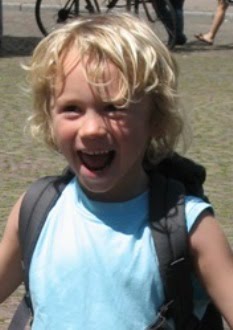
Ultimately, extensive walking was something we did nearly every day during our sojourn in Germany. The forest is often only steps away from the urban neighborhoods and the open air cafes and downtown pedestrian plazas beckon one to visit and linger during the summer months. Toby was eager to don a small backpack that included water, a magnifying glass, a map, and other items he considered essential for his new "career" as a spy, and both boys were easily enticed to walk longer distances by the offer of a scoop of Italian gelato at our destination. (Old Town Heidelberg, shown in the two photos below, is a very walkable city where we stayed with friends for a long weekend).

 Inspired by this new pedestrian existence (however brief) I've set myself the goal to walk at least 10 miles a week since returning.
To walk this distance requires about 200 minutes of my time each week, time which-- as a Mom working 9 hour days-- is in short supply for me. Thus, I'm forced to integrate walking into my normal daily routine. I now walk to work at the Government Center and back more often. I make an effort to walk to the post office or grocery/drugstore for smaller items and I often take the boys with me. I meet with friends to walk after work when I can. And as a family, we walk or ride our bicycles to Saturday morning soccer games, the public library, and the community swimming pool. After 14 years of Jochen gently urging me out of my car, I'm finally a convert!
I find that as I stop using my car, I don't feel as rushed. This is the paradox. Previously I drove from place-to-place precisely because I felt my quality of life was improved by the speed offered by a vehicle and the trip-linking I could do. I now realize that taking the time to stroll rather than drive (to work, for instance) allows me to experience the world in a provocatively different manner.
Over the past weeks I've observed the row of poplar trees along my route change color, I've breathed in the heady scents of new rain and freshly mowed grass, I've bundled myself against the biting wind, I've listened to the rythmic sound of crunching leaves beneath my feet, and I have more time to meditate and ponder.
I find that as I stop using my car, I don't feel as rushed. This is the paradox. Previously I drove from place-to-place precisely because I felt my quality of life was improved by the speed offered by a vehicle and the trip-linking I could do. I now realize that taking the time to stroll rather than drive (to work, for instance) allows me to experience the world in a provocatively different manner.
Over the past weeks I've observed the row of poplar trees along my route change color, I've breathed in the heady scents of new rain and freshly mowed grass, I've bundled myself against the biting wind, I've listened to the rythmic sound of crunching leaves beneath my feet, and I have more time to meditate and ponder.
I ask myself why our southern California culture is so enamored with a car-centric existence? What do we gain from losing our connection to the outdoor world and racing at breakneck speed to every location in larger, more comfortable vehicles? What do our children learn with this as a model?
Here's to more time spent on foot and bicycle!


No comments:
Post a Comment